
The History of Whiskey Row Louisville: From 1800s Bourbon Capital to Modern Revival
Last Updated: Apr 24, 2026
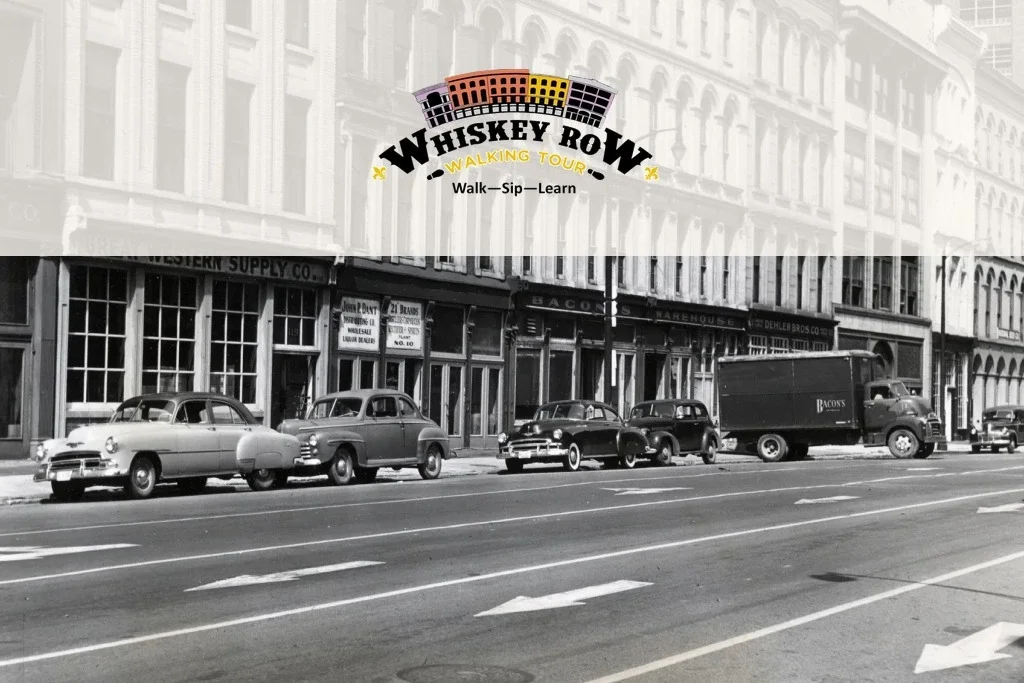
Why I Tell This Story on Every Single Tour
I've been a professional tour guide on Whiskey Row for fifteen years, and before that I spent 22 years working in the City of Louisville's Economic Development Department. In both of those roles, I've watched this block go from a neglected strip of aging buildings to one of the most visited bourbon destinations in the world. I have a particular attachment to this history -- not because I read it in a book, but because I lived through part of it, and because I've spent over a decade helping other people understand why it matters.
The history of Louisville’s Whiskey Row is not a simple story. It has a magnificent beginning, a near-total collapse, a narrow escape from demolition, and a revival that nobody in this city fully anticipated. I'm going to take you through all of it.
The Origins: Louisville and the Ohio River
To understand why Whiskey Row exists at all, you have to understand Louisville's geography. The city was founded in 1778 at the Falls of the Ohio River -- the one point along the river's 981-mile length where navigation required a stop. That geographic accident made Louisville an unavoidable waypoint for goods moving in every direction across the early American frontier. Barges heading south to New Orleans, river boats heading east to Cincinnati and Pittsburgh, trains beginning to crisscross the continent -- all of them passed through Louisville.
Kentucky's soil was extraordinarily fertile, and its farmers were producing surplus grain -- corn, rye, barley -- faster than they could transport or sell it. Distillers recognized an opportunity: buy the surplus cheap, convert it into whiskey, and ship this Liquid Gold into whiskey barrels that were far easier to move. This is how the bourbon industry was born in Kentucky and at its roots ingrained into its culture that still survives today. And Louisville, sitting at the center of those logistics, was the natural place to do business.
The Golden Era: 1840s to 1919
By the 1840s, Main Street -- one block from the Ohio River -- had become so crowded with whiskey firms, sales agents, warehouses, and distillery offices that locals had a name for it: Whiskey Row. The 100 blocks of East and West Main Street was, at its peak, the Wall Street of bourbon. Every major distillery in Kentucky had a presence here. Brown-Forman held offices at 117 West Main. J.T.S. Brown and Sons operated at 105 and 107 West Main. Firms from across the state converged on this two block stretch to warehouse, blend, trade, and ship their product.
The buildings that went up during this period were designed to announce success. Between 1852 and 1905, eleven major commercial buildings were constructed along the 100 block of West Main, featuring Renaissance Revival facades, Beaux Arts detailing, and Chicago School horizontals with cast-iron storefronts imported from Europe. Cast iron was expensive and time-consuming to install -- firms used it because they wanted the country to know that Louisville was a large scale industrial and profitable city.
By the turn of the 20th century, Whiskey Row was the trading center not just for Kentucky bourbon but for distilled spirits coming in from Pennsylvania, Virginia, and West Virginia as well. Whiskey was warehoused here, blended with Kentucky bourbon, and shipped south to New Orleans or west to St. Louis and then across the frontier. Louisville had become, in the most literal sense, the distribution hub of American whiskey. I always remind my guests that when they are standing on this block, they are standing on the ground where the bourbon industry as we know it was built.
Prohibition: The End of Everything
On January 17, 1920, the Volstead Act took effect and the bourbon industry on Whiskey Row went dark almost overnight. Distilleries closed. Sales offices emptied. The warehouses that had stored tens of thousands of barrels of aging bourbon were either repurposed or abandoned. The commercial ecosystem that had sustained this block for nearly 80 years simply ceased to exist. Louisville suffered the most from Prohibition than any other city in the U.S. by losing over 10,000 jobs. 33% of the total work force employment that made up river boat and rail road shipping jobs were now unemployed.
Brown-Forman was one of the rare survivors. The company held one of only six federal licenses in Kentucky to produce and sell whiskey for medicinal purposes during Prohibition, which allowed it to maintain a limited operation through the dry years. But it was the exception. For most of the firms on Whiskey Row, Prohibition was the end.
When Repeal came in 1933, the bourbon industry did not simply restart on Main Street. The economics had changed with the Great Depression underway and the infrastructure had deteriorated. Production shifted to larger facilities outside the city. Brown-Forman moved its operations to a site at 18th and Howard Streets. The block that had defined American bourbon for nearly a century was left behind.
The Long Silence: Mid-20th Century Decline
For the next several decades, the buildings on Whiskey Row sat in a kind of limbo. They were structurally significant -- too expensive to demolish casually, too old and underinvested to attract major tenants. The magnificent facades remained, but the businesses inside them had nothing to do with bourbon. Coin dealerships. Accounting firms. Nightclubs. Warehouses storing goods that had no connection to the history of the block.
By the 1990s and early 2000s, the situation had become critical. The buildings were deteriorating. Deferred maintenance had accumulated over decades. In 2001, the buildings at 101-103 West Main Street collapsed entirely -- gone. The rest of the block was placed on Louisville's Most Endangered Historic Places list, and by 2011 developers were actively pushing for demolition. The argument was straightforward: the land was valuable, the buildings were liabilities, and there was no obvious path to making them economically viable.
I can tell you that the fate of this block was genuinely uncertain. The case for preservation was a harder sell than people remember today. It took a coalition of architects, historians, preservationists, city officials, and private developers working together over several years to save what you see on Whiskey Row today. That coalition deserves credit that it rarely receives.
The Near-Demolition and the Save
The preservation agreement that saved Whiskey Row was finalized around 2011, and it was not a foregone conclusion. The deal required the city to work with private developers who were willing to take on the financial risk of restoring these buildings, with the understanding that the restored properties would serve as the anchor of a revitalized downtown bourbon district. The National Register of Historic Places listing in 2010 provided some federal protection and tax incentive access, but the real work was done by people who believed in the long-term value of the block.
What followed was one of the most significant preservation and development projects in Louisville's recent history. Building by building, the 100 block of West Main was restored -- facades cleaned and repaired, interiors gutted and rebuilt, new uses found that honored the original character of the block. The process took years. Some buildings were completed before others. But the intention was clear from the beginning: Whiskey Row was going to come back as a bourbon district.
The Modern Revival: 2013 to Today
The catalyst for the modern revival was the Evan Williams Bourbon Experience, which opened at 528 West Main Street in 2013. It was the first major bourbon tourism investment on the strip in the post-Prohibition era, and it changed the conversation about what Whiskey Row could be. Not just a preserved historic district -- a living, working bourbon destination where visitors could walk in off the street, learn the history, taste the product, and connect the past to the present.
What followed was a wave of openings that transformed the district within a decade. Old Forester returned to its original address at 119 West Main in 2018 -- the same building where Brown-Forman had bottled whiskey from 1882 to 1919. Bardstown Bourbon Company opened a satellite tasting room and blending experience at 730 West Main. In 2023, Buzzard's Roost established a micro-still and tasting room that has become one of the most education-focused stops on the strip. Top Bat Bourbon, in 2022, brought a custom blending concept that lets visitors create their own bourbon. In 2025 Pursuit Spirits opened their location and added another dimension to an already remarkable lineup.
Today, Whiskey Row is home to more working distilleries and tasting rooms than at any point in its history -- and unlike the original Whiskey Row, which was primarily a trading and warehousing district, the modern version is designed to be experienced. You can walk in, watch bourbon being made, sit down with a knowledgeable guide, and taste spirits that reflect over 250 years of accumulated craft. That accessibility is new. That intimacy is new. The history is not.
What the History Means When You're Standing on the Block
I end every tour at the corner of First and Main, and I always say the same thing: you are standing on one of the most historically significant blocks in American commercial history. Not just bourbon history. American history. The decisions made on this block -- by the distillers, the traders, the families who built these buildings -- shaped the bourbon industry that the entire world drinks today.
Understanding that history is what transforms a tasting into something more. It is what turns a pleasant afternoon into a genuine experience of this place. That is what I built the Whiskey Row Walking Tour to provide, and after fifteen years, it is still the part of this job that I love most.
Ready to experience Whiskey Row for yourself? Come tour Whiskey Row alongside me in real life. Book your spot at whiskeyrowwalkingtour.com and I will see you on the Row.
About the Author
Drew Shryock | Lead Guide & Owner, Whiskey Row Walking Tour
I'm Drew Shryock, owner and lead guide of the Whiskey Row Walking Tour. I've spent fifteen years studying and telling the history of this block, and twenty-two years before that working in Louisville's Economic Development Department -- including during the years when Whiskey Row's fate was genuinely uncertain. The history in this post is not secondhand. I watched part of it happen.
If this history resonates with you, I'd love to walk you through it in person. There is no substitute for standing on the block itself.